File: IMG_7759.jpeg 📥︎ (122.79 KB, 1326x720) c74e305e3cf38f8de32bc87abcc67331918da44e6eb198906ec5b34d91164cb20ImgOps
№4308162[Quote]
I have more than fifty questions asked - to clarify, by the permission of Allah al-`Azim, the kufr inherent in voting. Bi-'idhni 'Llahi al-`Azim, we shall now continue.
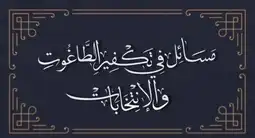
- Masa'il fi Takfir al-Taghut wa'l-Intikhabat-
(Issues Concerning the Takfir of the Taghut and the Matter of Elections)
"Doctrines of Democracy, Ba`thism, and Other Heretical Philosophies and Man-Made Laws - Explained through the Creed of Ahl at-Tawhid wa'l-Athar"
Among the most striking examples of false doctrines founded upon kufr is Ba`thism - which is in essence identical to Democracy and Secularism in principle and foundation.
Ba`thism or Democracy or Secularism and their Sister's (other Religions) are built upon the notion that there exists no distinction among mankind based upon din (religion), color, or lineage, and that al-wala' wa'l-bara' (loyalty and disavowal) are due solely to party allegiance, not to belief in Allah and His Messenger.
It is reported that Saddam Husayn once declared:
"If you are a Ba`thi, then you have more sanctity in my sight than `Umar ibn al-Khattab - radiya 'Llahu `anhu."
This statement encapsulates the kufr essence of Ba`thism.
Likewise, the Democrats and Secularists of our time share this very creed. They assert - either in word or in practice - that whoever belongs to their democratic or secular ideology possesses greater sanctity than Muhammad ibn `Abd Allah - sallallahu `alayhi wa sallam, and that the law of men is above the Shari`ah of Rabb al-`Alamin. Wa na`udhu bi'Llahi min dhalik.
Thus, just like democracy, these systems are founded upon kufr from their very core. The same applies to liberal constitutions, which sever the religion of Allah from governance and proclaim:
"Religion belongs in the mosque, while politics is another matter - and the two shall never meet."
Such statements constitute clear and manifest kufr. Whoever believes in or upholds such a principle is himself a kafir mushrik.
* Regarding the Salute to the Flag or Honouring the Hymn of the Flag and the Country.
Reflect upon those who salute the modern national flags. These flags are not like the banners of old which merely symbolized tribal identity or lineage. Today's flags represent entire creeds/religions of kufr - ideologies such as Ba`thism, Democracy, Secularism, and most prominently Nationalism.
They have become among the most manifest sha`a'ir al-kufr (symbols of disbelief). Raising and honoring them holds the same legal weight as raising or wearing the Cross, and the scholars of Islam have agreed ijma`an (by consensus) that whoever exalts the Cross is a kafir.
Thus, whoever salutes or glorifies a flag representing kufr falls under the same ruling as one who glorifies the Cross. And whoever doubts the kufr of such a person - while knowing the meaning and symbol of that banner - is himself in doubt regarding Tawhid, and whoever doubts the kufr of a kafir has disbelieved.
* On Man-Made Laws and the Reality of Kufr in Governance
~ Note: On the Creed Concerning al-Hakimiyyah
It must be known that our creed concerning al-Hakimiyyah (Divine Sovereignty and Judgment) is firmly built upon the usul (principles) of the Salaf as-Salih - and that, in its foundational reality, the matter of ruling by other than what Allah revealed (al-hukm bi-ghayr ma anzala 'Llah) may constitute kufr duna kufr (disbelief lesser than major disbelief), depending on the nature and intent of the act.
Thus, whoever rules by other than the law of Allah, or seeks judgment from other than Allah's revelation, has indeed committed a sin, so long as he upholds Tawhid and the Sunnah upon the land he governs.
Accordingly, if such a ruler:
rules by his own hawa' (desire), or
replaces portions of the Shari`ah with other laws, without claiming that those laws are from Allah, or
does not perform istihlal (declaring the prohibited lawful), or jhud (denial) of the laws of Allah, or
does not prefer his own legislation over the Shari`ah of Allah -
then he remains a Muslim sinner (`asi muslim), and his act constitutes kufr asghar (minor disbelief) rather than major apostasy.
However, we do not halt at this generalization.
Indeed, al-hukm (ruling) and at-tahakum (seeking judgment) can, in our present era, fall into major kufr through various specific scenarios - which, insha'Allah, shall be clarified and demonstrated in what follows:
A). As for the man-made laws enforced by today's rulers, te root of their kufr does not lie merely in their permitting or forbidding matters contrary to revelation. Rather, the essence of kufr is found in their criminalization of the Shari`ah - labeling the commands of Allah as crimes.
(1/2)
№4308165[Quote]
For example, if a ruler were to declare:
"Using the miswak (tooth-stick) according to the Sunnah is a punishable offense,"
or "Jihad fi sabili'Llah is terrorism and punishable by law,"
or "Destroying idols or statues is a crime against the nation,"
or he allows the Religion to be mocked openly.
- then such rulings constitute open war against the Din of Allah.
This differs entirely from one who rules by other than what Allah revealed out of hawa' (personal desire) or injustice, while still acknowledging that the Shari`ah is truth and justice.
The first is a kafir muharib li'Llah (a disbeliever waging war against Allah), whereas the second is a `asi muqirr (a transgressor who admits the truth yet falls short in action).
B). On Those Who Appeal to the Courts of Disbelief
Likewise, whoever knowingly seeks judgment from a taghuti legal system which criminalizes the laws of Allah is himself a kafir.
For instance, if one goes to a secular court and complains, saying:
"So-and-so committed a crime,"
while what he calls a "crime" is actually an act of obedience to Allah - such as implementing the Shari`ah - then such a person has sought hukm bi-ghayr ma anzala 'Llah (judgment by other than what Allah revealed) in a manner constituting ridda (apostasy).
However, if one resorts to such courts for purely dunyawi matters (worldly disputes) without believing in or criminalizing the Shari`ah, he is a sinner, not a kafir - yet remains in grave danger.
These are weighty and delicate matters, not to be spoken upon except by those firmly grounded in knowledge.
Whoever enters these discussions from among the seekers of knowledge must precisely define the manatat al-kufr (the specific grounds of disbelief) - according to the understanding of Ahl as-Sunnah wa'l-Jama`ah, steering clear of kalam (speculative philosophy) and emotional extremism.
For the Din of Allah is one, clear, and perfect - while the deviations of the people are many. Their innovations and desires distort the pure objectives of Din and the pristine foundations of Tawhid.
- Why Are Democratic Elections Acts of Disbelief (Kufr)? -
The Answer:
Because democratic elections are founded upon Kufr-based Conditions, and whoever participates in them does so with full approval of those conditions. Indeed, one is not permitted to participate in such elections unless he accepts these very principles.
(2)
№4308166[Quote]
Among their essential conditions are the following:
1. Freedom of Choice:
It is required that all voters possess independent and unrestricted rights of choice, without pressure or influence from any side.
2. Equality:
All voters must have the same opportunities and rights to participate in the election - regardless of their social standing, wealth, or position.
3. Transparency:
The election process must be open to public scrutiny, with results announced precisely and any act of fraud or corruption publicly exposed.
4. Justice:
The elections must ensure the recognition of the voters' rights without discrimination on the basis of race, religion, gender, sect, or ethnicity.
* I Said:
№4308167[Quote]
>I have more than fifty questions asked - to clarify, by the permission of Allah al-`Azim, the kufr inherent in voting. Bi-'idhni 'Llahi al-`Azim, we shall now continue.
>- Masa'il fi Takfir al-Taghut wa'l-Intikhabat-
>
>(Issues Concerning the Takfir of the Taghut and the Matter of Elections)
>"Doctrines of Democracy, Ba`thism, and Other Heretical Philosophies and Man-Made Laws - Explained through the Creed of Ahl at-Tawhid wa'l-Athar"
>
>Among the most striking examples of false doctrines founded upon kufr is Ba`thism - which is in essence identical to Democracy and Secularism in principle and foundation.
>
>Ba`thism or Democracy or Secularism and their Sister's (other Religions) are built upon the notion that there exists no distinction among mankind based upon din (religion), color, or lineage, and that al-wala' wa'l-bara' (loyalty and disavowal) are due solely to party allegiance, not to belief in Allah and His Messenger.
>
>It is reported that Saddam Husayn once declared:
>
>"If you are a Ba`thi, then you have more sanctity in my sight than `Umar ibn al-Khattab - radiya 'Llahu `anhu."
>
>This statement encapsulates the kufr essence of Ba`thism.
>
>Likewise, the Democrats and Secularists of our time share this very creed. They assert - either in word or in practice - that whoever belongs to their democratic or secular ideology possesses greater sanctity than Muhammad ibn `Abd Allah - sallallahu `alayhi wa sallam, and that the law of men is above the Shari`ah of Rabb al-`Alamin. Wa na`udhu bi'Llahi min dhalik.
>
>Thus, just like democracy, these systems are founded upon kufr from their very core. The same applies to liberal constitutions, which sever the religion of Allah from governance and proclaim:
>
>"Religion belongs in the mosque, while politics is another matter - and the two shall never meet."
>
>Such statements constitute clear and manifest kufr. Whoever believes in or upholds such a principle is himself a kafir mushrik.
>
>* Regarding the Salute to the Flag or Honouring the Hymn of the Flag and the Country.
>
>Reflect upon those who salute the modern national flags. These flags are not like the banners of old which merely symbolized tribal identity or lineage. Today's flags represent entire creeds/religions of kufr - ideologies such as Ba`thism, Democracy, Secularism, and most prominently Nationalism.
>
>They have become among the most manifest sha`a'ir al-kufr (symbols of disbelief). Raising and honoring them holds the same legal weight as raising or wearing the Cross, and the scholars of Islam have agreed ijma`an (by consensus) that whoever exalts the Cross is a kafir.
>
>Thus, whoever salutes or glorifies a flag representing kufr falls under the same ruling as one who glorifies the Cross. And whoever doubts the kufr of such a person - while knowing the meaning and symbol of that banner - is himself in doubt regarding Tawhid, and whoever doubts the kufr of a kafir has disbelieved.
>
>* On Man-Made Laws and the Reality of Kufr in Governance
>
>~ Note: On the Creed Concerning al-Hakimiyyah
>
>It must be known that our creed concerning al-Hakimiyyah (Divine Sovereignty and Judgment) is firmly built upon the usul (principles) of the Salaf as-Salih - and that, in its foundational reality, the matter of ruling by other than what Allah revealed (al-hukm bi-ghayr ma anzala 'Llah) may constitute kufr duna kufr (disbelief lesser than major disbelief), depending on the nature and intent of the act.
>
>Thus, whoever rules by other than the law of Allah, or seeks judgment from other than Allah's revelation, has indeed committed a sin, so long as he upholds Tawhid and the Sunnah upon the land he governs.
>
>Accordingly, if such a ruler:
>
>rules by his own hawa' (desire), or
>
>replaces portions of the Shari`ah with other laws, without claiming that those laws are from Allah, or
>
>does not perform istihlal (declaring the prohibited lawful), or jhud (denial) of the laws of Allah, or
>
>does not prefer his own legislation over the Shari`ah of Allah -
>
>then he remains a Muslim sinner (`asi muslim), and his act constitutes kufr asghar (minor disbelief) rather than major apostasy.
>
>However, we do not halt at this generalization.
>
>Indeed, al-hukm (ruling) and at-tahakum (seeking judgment) can, in our present era, fall into major kufr through various specific scenarios - which, insha'Allah, shall be clarified and demonstrated in what follows:
>
>A). As for the man-made laws enforced by today's rulers, te root of their kufr does not lie merely in their permitting or forbidding matters contrary to revelation. Rather, the essence of kufr is found in their criminalization of the Shari`ah - labeling the commands of Allah as crimes.
>(1/2)
№4308169[Quote]
-Firstly:
The very foundation (asas) of democratic elections is liberalism - and this, in and of itself, is a condition of disbelief (shart kufri) for whoever adopts it. Thus, there is no consolation for the Ikhwan al-Mushrikin (the polytheistic Kafirs who falsely call themselves the "Muslim Brotherhood").
-Secondly:
Among its conditions is that religion may not be a factor in one's choice, and that what they call "justice" is, in reality, the abandonment of choice on the basis of religion.
-Thirdly:
Democratic elections criminalize choosing on the basis of religion, and this is nothing less than a criminalization of what Allah has revealed (tajrim lima anzala 'Llah).
Thus in Conclusion, These elections - and those similar to them - generally do not grant the right of participation freely unless the voter accepts the conditions of the constitution or the terms of the election, and all of these conditions contain elements of kufr.
So again, why Is Voting within Democratic or Republican Systems Itself an Act of Kufr?
Because such voting is a selection of whom they deem "the most suitable for the nation" (al-aslah li'l-bilad) - yet, in truth, no Kafir can ever be "most suitable."
This is especially evident in the era of political parties and their representatives, whose entire platforms are built upon the rule of disbelief.
Voting (taswit) thus differs entirely from mere selection (ikhtiyar).
Ikhtiyar mujarrad (simple choice) refers to a neutral act of choosing, detached from any legislative or ideological foundation.
Whereas taswit (voting) - as defined in their systems - is a deliberate act of choosing the "most suitable" for the governance of the nation.
Hence, although one form of kufr may appear lesser in harm than another, none of them can ever be "more suitable", for disbelief, regardless of degree, remains disbelief.
As for one who intentionally appoints a kafir to oversee an affair of the Muslims, without participating on These Systems of Kufri Religions such as Voting in Democracy and Secularism or Liberalism, then such an act is indeed a sin, though it may not reach major disbelief if it lacks rida or istihlal.
However, voting, as defined in their constitutions, is far more severe - for it is a ritualized choice based on "national benefit" rather than religion, and entry into it usually requires acceptance of explicit conditions of kufr and participation in a process that itself legislates independently of the Shari`ah.
If one should ask: "Why are these four democratic conditions that they impose upon the people before allowing them to vote considered kufr in the Din of Allah?"
№4308170[Quote]
We answer:
Because what they call "freedom of choice" is in fact the removal of religion from judgment - and that is kufr. And the voter adheres to this Condition if he has made up his mind to vote, thus he is a Kafir.
Their so-called "equality" is to make the rights of the kafir equal to those of the Muslim - and that is kufr. And the voter is made to adhere to this.
Their "transparency" is the obligation to conform to the secular, kufri foundations they have established - and to regard opposing them as corruption - and that is kufr. And the voter is made to adhere to this.
Their "justice" is the granting of equal standing and recognition to Muslim and kafir alike, without distinction between iman (faith) and kufr - and that is kufr. And the voter is made to adhere to this condition aswell.
So we ask:
Is the so-called "freedom of choice," in which religion is set aside, not disbelief?
Or their claim under "equality," that the rights of the disbeliever are equal to the rights of the Muslim - is that not kufr?
Or their statement under "transparency," that integrity means conforming to these kufri foundations, while corruption means opposing these kufri foundations - is that not kufr?
Or their assertion under "justice," that it is the protection of all electoral opportunities and the recognition of the "rights" of all voters - whether they be disbelievers or Muslims - without any distinction between them - is that not kufr?
They fabricate for the Kuffar invented entitlements and call them "rights," though Allah - `azza wa jall - has revealed no such thing. To affirm such falsehood and to legislate what Allah never revealed - this itself is kufr bi-Allah wa bi-Shar`ih.
They call these huquq al-kafir - "the rights of the disbeliever" - and that itself is kufr: that they invent for the disbeliever so-called "rights" and call them rights, though Allah has revealed nothing that designates them as such.
The voter commits kufr, for the very meaning of intikhab (election) is "to choose the most suitable or the best," for the nation and a kafir can never be salih (righteous).
The meaning of intikhab is to select the "better one," yet a kafir is never better than another kafir, he may only be less evil than the other.
A mere act of choosing (ikhtiyar mujarrad) is not kufr in itself -
but intikhab (voting within the democratic or any systematic framework) is kufr in itself.
For the concept of intikhab is intrinsically defined as choosing the "most suitable" or "the best among them."
The matter is that democracy is itself a din (religion), and it commands adherence to its creed.
It says to its followers:
"Vote, for you have the right to vote,"
or it says,
"The Republic of Kosovo, or Albanian or Britain, or Morocco or any country grants you this right to vote."
№4308172[Quote]
Both are nearly identical in essence.
Democracy and republicanism never tell the people, "Choose freely without restriction."
Rather, they impose shurut kufriyyah (disbelieving conditions) which we emphasized earlier and they label this process of choice or casting a vote as "election," which means they are commanding the people with kufr. And when the people obey this command, they fall into kufr thereby.
They do not say "Choose" (ikhtaru) in a neutral sense, they say "Elect" (intakhibu).
The meaning of taswit (voting) or ikhtiyar (choosing) is much broader:
A man might choose his cousin merely because he loves him, or because he shares his religion, or he may choose someone simply out of whim or negligence.
But intikhab - as defined - means selecting the "most suitable" or the "best among them," and a kafir can never be "the most suitable" (al-aslah) nor "the best" (al-khayr) among a group of kuffar, for he possesses no goodness, his judgments are void, his wilayah (authority) invalid, and thus he can never be the aslah nor the khayr among those of disbelief.
If a ruler commands the people to "choose," this is a ma`siyah (sin), for it is judgment by other than what Allah - `azza wa jall - has revealed.
The ruling of Allah - `azza wa jall - is that Ahl al-hall wa'l-`aqd (those of binding and loosening authority) select whom they see as most fit in the Shar`i sense, and the ruler has the right to appoint or remove those whom he deems best by Shari`ah.
Now someone might ask: But what if someone casts a vote merely to waste his vote, not because he genuinely believes he is "electing the best among them"?
The answer:
Democracy, secularism and republicanism are all calls to a false din (religion). If they tell a person, "Elect," and he responds and elects, then he has committed kufr - whether he intended it or not - for he has entered under their shurut al-kufr (conditions of disbelief).
Not only that - the very act of responding to the call of intikhab
is in itself obedience to a command of kufr, and his intention changes nothing in the ruling.
It is like a man being commanded to prostrate to an idol (sanam):
if he claims, "I intend this prostration for Allah,"
he is nonetheless a kafir mushrik, for he has shared the form of worship with other than Allah - `azza wa jall - and his intention carries no effect upon the cause (`illah) of disbelief.
Thus, democratic intikhab is kufr bi-dhatih (disbelief by its very nature), its structure is disbelief, its terminology is disbelief, and its obedience is disbelief.
№4308174[Quote]
>>4308167Shut your ass up mushrik
№4308180[Quote]
is this halal or haram?
№4308196[Quote]
>>4308190Ok can we meet half way please
№4308347[Quote]
Just clean the toilets lil bro🤣🤦